World Fastest computer - Fugaku
Hardware
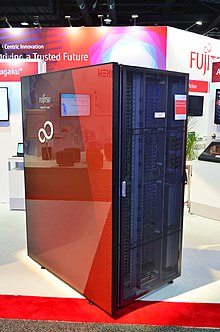
The supercomputer is built with the Fujitsu A64FX microprocessor. This CPU is based on the ARM version 8.2A processor architecture, and adopts the Scalable Vector Extensions for supercomputers. Fugaku was aimed to be about 100 times more powerful than the K computer (i.e. a performance target of 1 exaFLOPS).
The initial (June 2020) configuration of Fugaku used 158,976 A64FX CPUs joined together using Fujitsu's proprietary torus fusion interconnect. An upgrade in November 2020 increased the number of processors.
Software
Fugaku will use a "light-weight multi-kernel operating system" named IHK/McKernel. The operating system uses both Linux and the McKernel light-weight kernel operating simultaneously and side by side. The infrastructure that both kernels run on is termed the Interface for Heterogeneous Kernels (IHK). The high-performance simulations are run on McKernel, with Linux available for all other POSIX-compatible services.[16][17][18]
Besides the system software, the supercomputer has run many kinds of applications, including several benchmarks. Running the mainstream HPL benchmark, used by TOP500, Fugaku is at petascale and almost halfway to exascale. Additionally, Fugaku has set world records on at least three other benchmarks, including HPL-AI; at 2.0 exaflops, the system has exceeded the exascale threshold for the benchmark. A description of that benchmark is as follows:
- The solver method of choice is a combination of LU factorization and iterative refinement performed afterwards to bring the solution back to 64-bit accuracy. The innovation of HPL-AI lies in dropping the requirement of 64-bit computation throughout the entire solution process and instead opting for low-precision (likely 16-bit) accuracy for LU, and a sophisticated iteration to recover the accuracy lost in factorization.
Performance
The reported initial performance of Fugaku was a Rmax of 416 petaFLOPS in the FP64 high performance LINPACK benchmark used by the TOP500. After the November 2020 upgrade in the number of processors, Fugaku's performance increased to a Rmax of 442 petaFLOPS.
Fugaku also attained[when?] top spots in other rankings that test computers on different workloads, including Graph 500, HPL-AI, and HPCG. No previous supercomputer has ever led all four rankings at once.
After a hardware upgrade, as of November 2020, "Fugaku increased its performance on the new mixed precision HPC-AI benchmark to 2.0 exaflops, besting its 1.4 exaflops mark recorded six months ago. These represent the first benchmark measurements above one exaflop for any precision on any type of hardware." (a 42% increase) Interestingly, the Arm A64FX core-count was only increased by 4.5%, to 7,630,848, but the measured performance rose much more on that benchmark (and the system does not use other compute capabilities, such as GPUs), and a little more on TOP500, or by 6.4%, to 442 petaflops, a new world record and widening the gap to the next computer by that much. For the High-Performance Conjugate Gradient (HPCG) benchmark it's over 5.4x as fast, at 16.0 HPCG-petaflops, as the number two system, Summit,[23] that happens to also be second on TOP500.
Fugaku's performance surpasses the combined performance of the next 4 supercomputers on the top500 list (almost next 5) and surpasses by 45% margin all the other top-10 computers on HPCG benchmark.
History
On May 23, 2019, RIKEN announced that the supercomputer was to be named Fugaku. In August 2019, the logo for Fugaku was unveiled; it depicts Mount Fuji, symbolising "Fugaku's high performance" and "the wide range of its users". In November 2019, the prototype of Fugaku won first place in the Green500 list. Shipment of the equipment racks to the RIKEN facility began on December 2, 2019, and was completed on May 13, 2020. In June 2020, Fugaku became the fastest supercomputer in the world in the TOP500 list, displacing the IBM Summit.
Fugaku has been used for research on masks related to the COVID-19 pandemic.
Cost
In 2018, Nikkei reported the programme would cost ¥130 billion (c. US$1 billion).


Comments
Post a Comment